Cranks but won't start
Often stale fuel and a gummed carburetor after months of storage, but ignition, fuel pump, and low oil shutdown all live on this list too.
Generator specialty
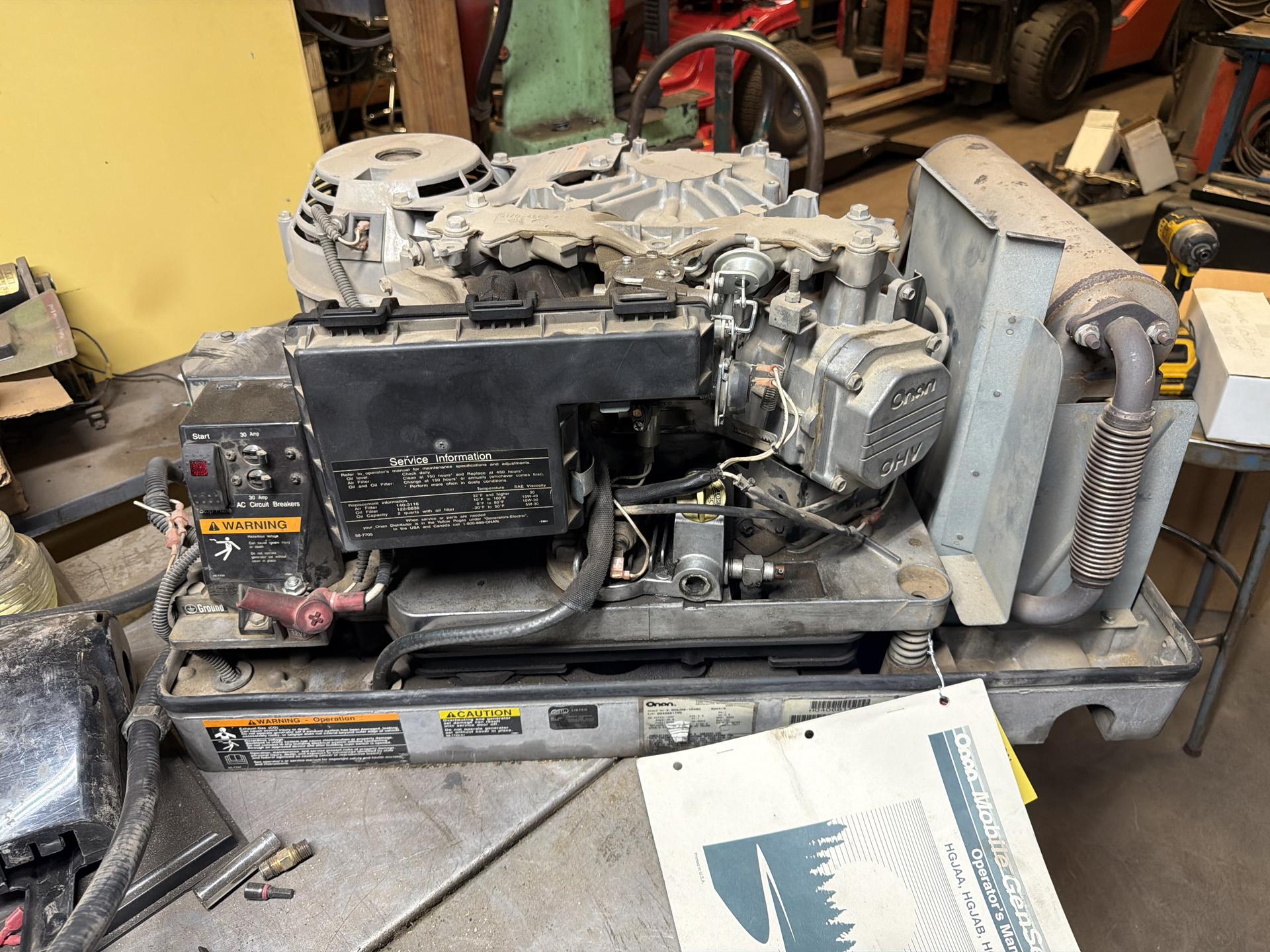
Generator work is where High Country RV started specializing, and it is still the service owners drive the farthest to get.
A generator is the one piece of equipment on your RV that has to work when nothing else does. Boondocking in the Kaibab, riding out a storm at a Williams campground, running the roof air on a 108-degree afternoon in Mesa — that is the moment a generator either earns its keep or ruins a trip. High Country RV bought an established RV service operation specifically to deepen its generator expertise, and that investment shows up in how these jobs get diagnosed.
Most generator complaints arrive sounding the same: it won't start, it starts and quits, or it runs but won't carry a load. Those three symptoms have very different causes, and the fastest way to waste your money is to start replacing parts before anyone has confirmed which one you actually have. We test first. Fuel delivery, spark, compression, oil level and pressure, battery voltage under crank, exhaust restriction, and the control board's own fault history all tell part of the story before a wrench comes out.
Symptoms we hear
Often stale fuel and a gummed carburetor after months of storage, but ignition, fuel pump, and low oil shutdown all live on this list too.
A classic fuel starvation or oil pressure signature. The generator proves it can run, which usually narrows the search quickly.
The unit sounds fine until the air conditioner kicks on, then it bogs, surges, or trips. Load testing separates engine problems from output problems.
Usually fuel metering or a governor issue. It gets worse at elevation, which is why Flagstaff owners notice it before valley owners do.
Stop running it and call. Exhaust and carbon monoxide concerns get treated as urgent, not scheduled at convenience.
The engine side may be perfect while a transfer switch, breaker, or output winding is the actual failure point.
Nearly all generator service happens where your RV already sits. Pulling a coach to a shop for a unit that is bolted into its own compartment rarely makes sense, and it usually costs you more in towing and downtime than the repair itself. We arrive with test equipment, common service parts, and the ability to run the unit under real load on site.
Working at your location has a diagnostic advantage too. A generator that misbehaves only at 7,000 feet, only after an hour of runtime, or only when your specific air conditioner cycles is far easier to catch in place than in a shop bay two counties away.
Northern Arizona sits between roughly 4,500 and 7,500 feet, and small engines lose meaningful power and run richer as air thins. A generator that was jetted and tuned for sea level will foul plugs, load up, and struggle to carry the same air conditioner it handled in Phoenix. Owners who winter in Mesa and summer in Flagstaff feel this twice a year.
We take elevation into account rather than treating it as an excuse. Correct fueling, clean air intake, healthy ignition, and proper exhaust flow matter more here than almost anywhere, and a unit that is genuinely healthy will still perform respectably up high once those basics are right.
The single biggest cause of generator failure we see is not wear. It is sitting. Fuel left in a carburetor for a season turns to varnish, exhaust systems collect moisture, oil breaks down whether or not the hours accumulate, and batteries sulfate until there is not enough crank left to matter.
A short annual service — oil and filter, spark plug, air and fuel filters, a load test, and a look at mounts, wiring, and exhaust — costs a fraction of a mid-trip failure and gives you a documented baseline. If you store your rig for months at a time, exercising the generator monthly under load is the cheapest maintenance available to you, and it is free.
Scope of work
From our work
How it works
01
Describe what the generator does and when. Model number, hour meter reading, and last service date help a great deal.
02
We test the systems the symptom points at, confirm the cause, and explain what we found in plain terms.
03
Where parts are on hand, the work happens the same visit. Then we run the unit under load to prove the fix.
“Bryon was excellent with communication, letting me know I can come in for service sooner than scheduled. He redid my entire PVC sewage line from tank to valve and saved me money by reusing undamaged parts. I totally recommend High Country RV.”
Before you call
We regularly service the units found in travel trailers, fifth wheels, and motorhomes, including common Onan and Generac RV models along with portable generators owners carry with them. Call with your model number and we will confirm before scheduling.
Related work
High Country RV is licensed and insured, and Bryon Honea handles generator work personally. If a unit is genuinely at the end of its service life, you will hear that instead of a quote for parts that only buy a few more hours.
Call 888-794-6755 with your generator model and what it is doing. Even over the phone, the symptom usually points somewhere useful.
Monday–Saturday, 7:00 AM–7:00 PM · 7337 Latigo Rd, Williams, AZ 86046