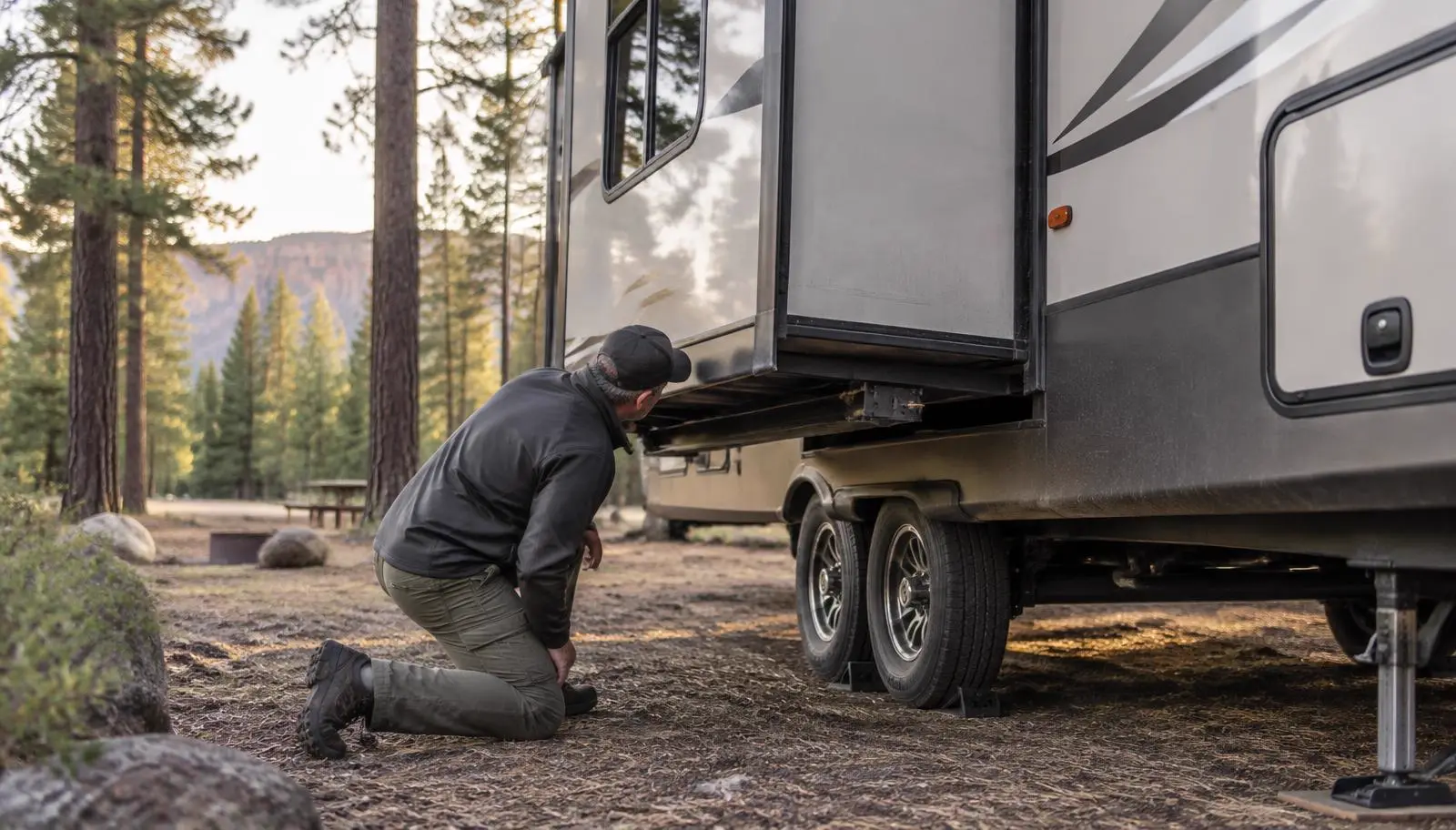
Slide-Outs
RV Slide-Out Stuck, Crooked, or Grinding? Causes and What Not to Do
· 5 min read
The slide stopped halfway, and checkout is at 11
The slide made a grinding noise, moved four inches, and stopped. Or one end came in and the other did not, and now it is crooked in the opening. The instinct is to keep holding the switch. Please do not. On a slide-out, the switch is not a solution. It is how a stripped gear becomes a bent rail.
The three common slide systems
Electric rack and pinion
Common on travel trailers and fifth wheels. A 12 volt motor drives a shaft with gears that run along toothed racks under the slide floor. Lippert's through-frame system is the classic example. These are strong and simple, and they are sensitive to voltage.
Hydraulic
Common on larger fifth wheels and Class A motorhomes. A pump pushes fluid to cylinders that move the room. They handle heavy slides well, and they leak, lose fluid, and develop air in the lines over time.
Cable and in-wall systems
Lippert Schwintek in-wall slides and cable driven Accu-Slide style systems use motors on each side of the room, synchronized by a controller. They save floor space and they go out of sync more often than the other two types.
The usual causes
- Low battery voltage. Slide motors draw 20 to 40 amps or more. A battery that runs lights fine can sag to 10.5 volts under that load, and the motor stalls or the controller faults. This is the most common cause by far, and it is worse in cold weather.
- A blown fuse or tripped breaker. Usually a 30 to 40 amp fuse or self-resetting breaker near the battery or in the distribution panel.
- Failed motor or controller. Motors wear out, and in-wall controllers throw fault codes when one side works harder than the other. Typical motor replacement runs $300 to $700 installed.
- Debris in the track. Pine needles, pinecones, small rocks, and ice on the slide roof or in the rails. In Flagstaff, snow and ice on the slide topper are a big one.
- Dry or torn seals. Wiper and bulb seals drag when they dry out in the Arizona sun. A torn seal can fold under the room and jam it.
- Slide out of sync. On in-wall and cable systems, one side moves farther than the other and the room racks in the opening.
Why holding the switch makes it expensive
When a slide binds, the motor keeps pushing. On a rack and pinion slide, that force goes into the gear teeth and the rack. On a hydraulic slide, it pushes the pump past its relief pressure and heats the fluid. On an in-wall system, one motor keeps driving while the other stalls, and the room twists.
A blown fuse or dead battery is a $10 to $150 fix. A stripped gear pack or bent rack is $500 to $1,500. A racked room with damaged seals, flooring, and walls can run past $3,000.
“Slides almost never fail all at once. They warn you with a noise first. Listen to it.”
Keeping a slide healthy in northern Arizona
Most slide problems we see in Flagstaff and Williams are slow problems. Seals dry out in the sun, pine needles build up in the rails, and the battery bank gets a little weaker every year until one cold morning it cannot push the room. A few habits prevent most of it.
- Clean and treat slide seals every few months with a rubber seal conditioner made for RVs. Do not use petroleum based products, which swell and break down the rubber.
- Sweep the slide roof before bringing it in. Snow, ice, pinecones, and needles on the topper get dragged into the seal and the opening.
- Run the slide with shore power or the generator on, so voltage stays up under load.
- Make sure the rig is level side to side before you extend. A twisted frame puts the room into a bind.
- Listen every time. A new noise is the cheapest warning you will ever get.
- Lube rack and pinion gear racks only with the product the manufacturer calls for. Some want dry lube, and grease collects grit.
Hydraulic owners should check the fluid level in the pump reservoir once a season with the rooms in, and look under the rig for drips at the cylinders and hose fittings. In-wall slide owners should watch for one corner leading the other as the room moves.
Using the manual override to travel
Every slide has a manual way to bring the room in. Look in your owner's manual first, because the method depends on the system.
- Rack and pinion: there is usually a square or hex shaft on the end of the motor, or a brake release. You disconnect power, release the motor brake, and turn the shaft with a drill on low speed or the supplied crank.
- Hydraulic: there is a manual release valve on the pump and often a hand pump or a manual crank on the motor. Open the valve as instructed and pump or crank the room in.
- In-wall systems: disconnect the motors and push the room in by hand, or use the override procedure on the controller. Some require two people to keep it square.
Once the room is in, lock or brace it for travel so it cannot creep out on the road. Then get it looked at before the next time you need it out.
When to call us
Owners can check voltage, fuses, debris, and seals, and lube the rails or seals with the manufacturer's recommended product. Call if the slide grinds, moves crooked, throws a fault code, leaks fluid, or you had to use the override. Slide motors, controllers, and wiring are handled through our RV electrical service, and seal and mechanism work falls under RV repair. We come to you around Flagstaff in season and in Mesa through the winter.
Common questions
Why did my RV slide-out stop working?
The most common cause is low battery voltage under load. Blown fuses, failed motors or controllers, debris in the track, dry seals, and sync problems are next.
How do I bring in a stuck slide-out?
Use your system's manual override: a crank or drill on the motor shaft for rack and pinion, a release valve and hand pump for hydraulic, or the controller override for in-wall systems.
Keep reading
Pre-Trip ·
Heading Down to the Valley for the Winter? The Pre-Trip Check That Saves the Trip
The run down I-17 drops 6,000 feet in about 140 miles. Here is what to check before you hitch up so the trip to the East Valley stays boring.
Read article: Heading Down to the Valley for the Winter? The Pre-Trip Check That Saves the Trip
Electrical ·
Why Your RV Batteries Die Every Winter, and What to Do Before November
A battery that sits in a Flagstaff storage lot all winter with a parasitic draw is dead by January. Here is how to keep it alive until spring.
Read article: Why Your RV Batteries Die Every Winter, and What to Do Before November
Heating ·
RV Furnace Blowing Cold Air or Not Lighting? Here's What Actually Fails
Your furnace runs in a fixed order, and it stops at the part that failed. Learn the sequence and you can tell a dead battery from a bad igniter in five minutes.
Read article: RV Furnace Blowing Cold Air or Not Lighting? Here's What Actually Fails